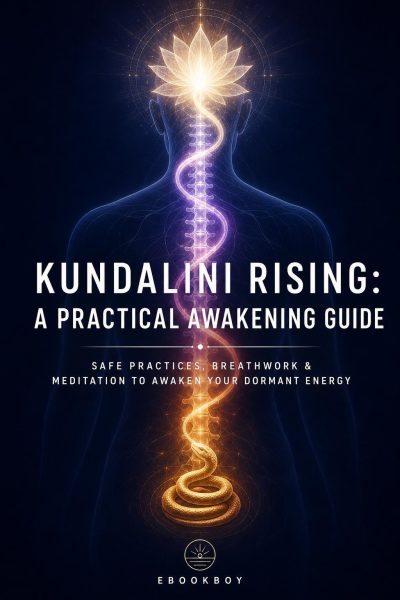
Kundalini Rising: A Practical Awakening Guide
Safe Practices, Breathwork & Meditation to Awaken Your Dormant Energy
EbookBoy · 107 pages · Edition 1 · Free sample: chapter 1
Chapter 1
The Sleeping Serpent: What Kundalini Really Is
The Ancient Image
Picture a serpent coiled three and a half times at the base of your spine, sleeping. This is the image that has anchored one of the most profound concepts in spiritual literature for at least two thousand years. The Sanskrit word kundalini comes from kundala, meaning "coiled one," and the metaphor is precise rather than decorative: the energy is latent, compressed, full of potential — like a spring wound tight, or a seed before it cracks open.
Most people carry this energy their entire lives without ever consciously touching it. It powers basic survival, sexual drive, digestion, the fight-or-flight response — the fundamental business of staying alive. Yogic tradition holds that when this same energy is cultivated, refined and directed upward through the central channel of the body, it becomes the engine of profound transformation: expanded perception, deep compassion, creative genius, and what the texts call samadhi — states of awareness so clear they feel like waking up inside a dream you didn't know you were having.
That is the promise. Before we talk about how to get there, let's talk about what it actually is — and what it isn't.
Not Just a Hindu Idea
Kundalini is most commonly associated with the Tantric and Shaivite traditions of India, and the classical texts — the Hatha Yoga Pradipika, the Shiva Samhita, the Sat-Cakra-Nirupana — are the richest sources of technical instruction we have. But the underlying concept appears across cultures in forms that are too consistent to be coincidence.
In Chinese medicine, qi (or chi) flows through meridians that map remarkably closely onto the yogic system of nadis — subtle energy channels. The central channel of the body is honoured in both systems as the primary axis of vitality. Taoist inner alchemy traditions describe a process of circulating and refining this energy upward through the body that parallels kundalini practice almost step for step.
The ancient Egyptians depicted the djed pillar — a symbol of stability and resurrection — as a vertical column associated with the spine of Osiris. Hermetic and Kabbalistic traditions speak of the Tree of Life as a vertical axis with ten sefirot (spheres of consciousness) that bear a structural resemblance to the chakra system. The caduceus — two serpents spiralling around a central staff — is a Greek symbol that most medical professionals display today without knowing it may encode the same energetic map: two opposing currents (ida and pingala in yogic terms) winding around the central channel.
None of this means every tradition is saying exactly the same thing. Cultural context matters, and forcing equivalences flattens important distinctions. But the convergence does suggest that human beings across radically different civilisations have been noticing, mapping and working with the same inner phenomenon — a concentrated life-force energy that can be awakened and directed.
That recognition is worth sitting with. You are not stepping into a fringe curiosity. You are stepping into one of humanity's oldest and most widely shared investigations.
The Anatomy of the System
To work with kundalini practically, you need a working map of the territory. Here is the essential framework, stripped of jargon.
The Three Channels (Nadis)
The yogic body contains thousands of nadis — subtle pathways through which prana (life-force energy) flows — but three are central to kundalini work:
- Sushumna: the central channel, running along the length of the spine from the base to the crown of the head. This is the highway kundalini travels when it rises.
- Ida: the lunar channel, beginning at the left nostril, associated with cooling, receptive, feminine qualities and the parasympathetic nervous system.
- Pingala: the solar channel, beginning at the right nostril, associated with heat, action, masculine qualities and the sympathetic nervous system.
In most people, prana flows primarily through ida and pingala, oscillating between them. The goal of many pranayama practices is to balance these two channels so that energy naturally moves into the central sushumna — creating the conditions for kundalini to rise.
The Seven Chakras
Along the sushumna are seven primary energy centres, each associated with specific physical regions, psychological themes, and qualities of awareness:
- Muladhara (Root) — base of the spine; survival, safety, belonging
- Svadhisthana (Sacral) — lower abdomen; creativity, pleasure, emotion
- Manipura (Solar Plexus) — upper abdomen; will, confidence, personal power
- Anahata (Heart) — centre of the chest; love, compassion, connection
- Vishuddha (Throat) — throat; expression, truth, communication
- Ajna (Third Eye) — between the eyebrows; intuition, perception, clarity
- Sahasrara (Crown) — top of the head; unity, transcendence, expanded awareness
Think of the chakras less as fixed objects and more as functional zones — like the different departments of a large organisation. When one department is blocked or overwhelmed, the whole organisation feels it. Kundalini work aims to clear and open each of these centres in sequence, so that energy can flow freely from root to crown.
What Awakening Actually Feels Like
Here is where most books either go too mystical or stay too vague. Let's be specific.
A kundalini awakening is not a single dramatic event that happens once and permanently transforms you. For most people, it is a gradual process — a series of openings, each followed by a period of integration. Spontaneous full awakenings do occur (sometimes triggered by intense trauma, grief, breathwork, or meditation retreat), but the path described in this book is a deliberate, graduated one. Slow is safe. Slow is also, paradoxically, faster in the long run.
Common physical sensations during early practice:
- Warmth or heat rising along the spine
- Tingling or buzzing in the hands, feet or crown of the head
- Involuntary movements — small tremors, rocking, the head gently nodding
- A feeling of pressure or fullness between the eyebrows
- Spontaneous deep breaths or sighing
- A sense of electricity or current moving through the body
Common emotional and mental experiences:
- Waves of joy or gratitude arising without obvious cause
- Old memories surfacing, sometimes with unexpected emotion attached
- A heightened sensitivity to other people's emotional states
- Periods of unusual creative flow or insight
- A temporary loosening of your sense of "normal" — things that used to feel urgent start to feel less so
What it is not (important distinctions):
Kundalini experiences are sometimes confused with psychiatric episodes, which is why this distinction matters. A genuine awakening experience, however intense, typically comes with an underlying sense of okayness — even when it is uncomfortable. There is usually a quality of witnessing, of being present to what is happening. If at any point you feel completely unable to function, lose touch with consensus reality for extended periods, or experience symptoms that frighten you, please stop practice and consult a mental health professional. Chapter 8 covers this in much greater detail, including a specific checklist. For now, simply know: this practice has a safety valve, and using it is not failure.
The Most Common Fears — Addressed Directly
"What if I can't handle it?"
This is the most common fear, and it is worth respecting rather than dismissing. The honest answer is: the practices in this book are designed to make the process manageable. We build slowly. We emphasise grounding as much as opening. The metaphor I find most useful is plumbing: before you increase the water pressure, you make sure the pipes are clear and solid. Preparation is not a preamble to the real work — it is the work.
"I've heard kundalini can make you go crazy."
Kundalini syndrome — a term used to describe overwhelming, unmanageable awakening experiences — is real, but it is almost always associated with forcing the process: intense practices done without preparation, without a teacher, without grounding, without integration time. Think of it this way: running a marathon is not inherently dangerous, but running one without training, without water, in extreme heat, is. The danger lies in the approach, not the destination.
"I'm not spiritual enough / I don't have the right background."
Kundalini is not an achievement awarded to the spiritually advanced. It is your own energy. You were born with it. The practices here simply help you become more consciously aware of what is already moving in you. No prior belief system is required. You do not need to be vegetarian, celibate, or initiated into any tradition to begin. A sincere intention and a willingness to show up consistently are the only real prerequisites.
"What if I accidentally awaken it and can't stop it?"
Reading a book about kundalini will not spontaneously awaken it. Beginning the early practices in this book will not either. What these early practices will do is gently increase your sensitivity and begin to move stagnant energy. Think of it as opening a window rather than blowing off the roof.
A Simple Self-Assessment Exercise
Before moving forward, take ten minutes with a journal and explore these questions honestly. There are no right answers — this is data, not a test.
1. Where do I feel most alive in my body right now? Notice which areas feel vibrant, warm, or energised. This often points to where your energy is currently most active.
2. Where do I feel numb, tight, or disconnected? These areas are your starting clues about where energy may be blocked or defended.
3. What draws me to this practice? Is it curiosity? A feeling of being stuck? A hunger for something you can't quite name? Write it down without editing.
4. What is my biggest fear about this process? Name it specifically. Vague fears have more power than named ones. Once it is on the page, you can work with it.
5. What does "awakening" mean to me right now? Whatever you write is fine. You will likely return to this question at the end of the book and find your answer has changed — and that shift will itself be evidence of the journey.
Keep these answers. They are your baseline.
The Role of a Teacher
Classical tradition is unambiguous on this point: kundalini work ideally happens under the guidance of a qualified teacher. A good teacher has walked the path themselves, can read subtle signs of imbalance, and can adjust your practice in real time. If you have access to a qualified kundalini yoga teacher, a Tantric lineage holder, or an experienced meditation guide, that relationship is worth cultivating.
That said, this book exists because most people do not have immediate access to such a teacher, or are not yet ready to find one, or are using it as a bridge to that relationship. Used responsibly — with the cautions heeded, the pacing respected, and honest self-monitoring in place — a structured written guide can be a genuine and safe starting point.
Think of this book as a detailed map. A map is not the same as a guide who knows the terrain personally. But a good map is infinitely better than wandering without one.
Your Intention Matters More Than You Think
In yogic tradition, sankalpa — a heartfelt intention or resolve — is considered one of the most powerful forces available to a practitioner. Before you begin any session in this book, you will be invited to set a brief intention. Not a goal in the transactional sense ("I want to feel enlightened by Thursday") but a direction — a quality you are moving toward.
For now, before you even begin the practices, try this:
Sit quietly for a moment. Place one hand on your heart and one hand on your lower belly. Take three slow, natural breaths. Then, silently or aloud, complete this sentence:
"I am beginning this practice because I want to know what it feels like to be fully ________."
Let the word or phrase arrive without forcing it. Alive. Present. Free. Open. Myself. Whatever comes is right.
That word is your compass. Write it on the first page of your journal. You will return to it.
Key Takeaways
- Kundalini is universal. The coiled life-force concept appears across Hindu, Taoist, Hermetic and other traditions — you are engaging with one of humanity's oldest and most widely shared enquiries.
- The system has a map. Three primary channels (sushumna, ida, pingala) and seven chakras give you a functional framework for understanding where energy moves and where it gets stuck.
- Awakening is a process, not an event. For most people it unfolds gradually through consistent practice, not in a single dramatic moment.
- Specific sensations are normal. Heat, tingling, emotional waves and involuntary movements are common early signs — they are information, not problems.
- Fear is worth naming. Unexamined fears slow the process; named and acknowledged fears become workable.
- Preparation is the practice. Rushing the process creates the very instability people fear. Everything in this book is designed to be graduated and grounded.
- Your intention is your anchor. A sincere sankalpa set at the beginning will orient your practice even on the days when nothing feels clear.