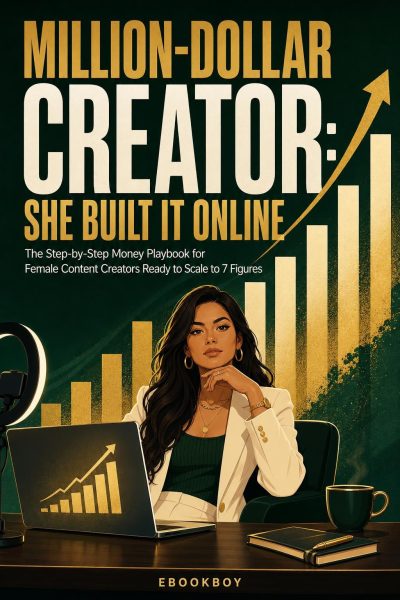
Million-Dollar Creator: She Built It Online
The Step-by-Step Money Playbook for Female Content Creators Ready to Scale to 7 Figures
EbookBoy · 100 pages · Edition 1 · Free sample: chapter 1
Chapter 1
You Are Already the Product — Start Acting Like the CEO
The Hard Truth Nobody Wants to Say Out Loud
Let's start with a number.
The average YouTube creator earns between $1 and $3 per thousand views through AdSense. That means if your video gets 100,000 views — which is genuinely impressive, the kind of number your friends screenshot and text you about — you walked away with somewhere between $100 and $300.
For a video that probably took you two to four days to research, film, edit, and promote.
That's not a content strategy. That's a hobby with extra steps.
Now compare that to what happened on the brand side. The company whose ad played before your video paid YouTube a rate closer to $10 to $30 per thousand impressions. YouTube kept the difference. You got the crumbs. And you said thank you by posting again next week.
This is not a rant against platforms. YouTube, TikTok, Instagram, Spotify — they built the infrastructure, the audience, the discovery engine. That's real value. But here's what they did not build: your business. That part is entirely on you. And most creators haven't started yet.
They're posting. They're growing. They're grinding. But they are not building a business. They are building someone else's.
The moment you understand that distinction — really feel it in your gut — everything changes.
You Are Running a Media Company. Act Like It.
Think about what you actually do as a creator.
You research topics your audience cares about. You develop a point of view. You produce content — scripted or spontaneous, polished or raw. You distribute it across platforms. You build an audience that trusts you enough to come back, week after week. You cultivate a community with its own culture, its own inside jokes, its own shorthand.
Now tell me: what does a media company do?
Exactly that.
The difference between you and a traditional media company isn't the work. It's the self-perception — and the business infrastructure that follows from it.
A media company doesn't just produce content and hope someone pays them. A media company owns its audience data, diversifies its revenue, licenses its intellectual property, builds products, negotiates deals from a position of value, and makes decisions based on margin and growth — not just reach and engagement.
You have already done the hardest part. You built the audience. You earned the trust. You created the content library. Now it's time to build the company around it.
The Employee Trap
Here is the trap most creators fall into, and it's subtle enough that you might not recognize yourself in it until it's pointed out.
Employees show up and do the work. They get paid for their time. They follow the rules of whoever owns the platform they work on. They don't set their prices. They don't own the customer relationship. They can be let go — or in a creator's case, shadowbanned, demonetized, or algorithm-buried — at any time, for reasons that are never fully explained.
Sound familiar?
When a creator's entire income depends on platform ad revenue and they post on a schedule dictated by what the algorithm rewards, they are functioning as an employee. A very entrepreneurial-looking employee, but an employee nonetheless.
The CEO of a media business thinks differently. She asks:
- Who owns the relationship with my audience? (Spoiler: if it's the platform, not you, that's a problem.)
- What happens to my income if this platform changes its algorithm next month?
- Am I building assets that compound in value, or just producing content that expires?
- Am I setting my prices, or am I accepting whatever rate someone offers me?
These are not questions employees ask. These are the questions that separate a creator with a job from a creator with a business.
What a Real Media Business Looks Like
Let me paint you a picture of two creators. Both have 80,000 YouTube subscribers and post twice a week. Same audience size. Completely different businesses.
Creator A earns from AdSense, makes about $2,000 a month in a good month, occasionally gets a brand deal for $1,500 that she underpriced because she was afraid they'd say no, and has been at this for two years. She's exhausted. She keeps hearing that she needs to "just grow bigger" before the money gets real.
Creator B earns from AdSense ($2,000), has two brand partnerships at $4,000 each per month, sells a $47 digital template pack that brings in $800 to $1,200 passively, runs a $19/month membership with 210 members ($3,990 recurring), and just launched a $397 mini-course that did $11,000 in its first week. Her monthly revenue is consistently between $15,000 and $22,000. Same audience size as Creator A. Completely different infrastructure.
The difference is not luck. It's not even talent. It's that Creator B made a decision — probably around month eight of feeling underpaid and overworked — that she was going to run this like a business.
That decision is available to you right now.
The Mindset Shifts That Actually Matter
Mindset chapters in business books can feel like filler. "Believe in yourself!" Great. Thank you. Very helpful.
So let's make this concrete. There are four specific belief shifts that have a direct, measurable impact on how much money you make as a creator. Not eventually. Now.
Shift 1: Your audience is an asset, not a vanity metric.
An audience of 10,000 people who trust you and buy from you is worth more than an audience of 500,000 passive scrollers. Stop chasing follower counts and start thinking about what percentage of your audience would pay for something valuable from you.
Even a 1% conversion rate on a $97 product with an engaged 5,000-person audience is $4,850 from a single launch. That's real money. And it's available to you right now, at your current size.
Shift 2: You set the prices.
One of the most expensive beliefs a creator can hold is that brands or customers decide what she's worth. They don't. You do — and then you communicate that with confidence. Underpricing doesn't make you more accessible. It makes you look less credible and it makes you resentful, which kills your creativity.
We'll get into exact rate formulas in Chapter 4. For now, just start practicing the belief that you are the one who names the number first.
Shift 3: Passive income is real, but it requires active building first.
The phrase "passive income" has been so thoroughly romanticized that it now means nothing. Here's the accurate version: some income streams, once built, continue generating revenue without proportional ongoing labor. That is real. A digital product you created once can sell every day for three years. A course you filmed last spring can generate enrollment while you sleep.
But it requires real work to build. The "passive" part comes later. Stop looking for shortcuts and start building the infrastructure.
Shift 4: You are not an influencer. You are a media business owner.
The word "influencer" was coined by marketers to describe someone whose attention they could rent. It positions you as a middleman — a conduit between a brand and an audience — rather than as the primary value creator.
Drop the word from how you describe yourself, at least in your own head. You are a media business owner who creates content, builds community, and generates revenue through multiple streams. That's not semantics. That's a completely different operating system.
Your First CEO Decision: The Audit
Before you post another piece of content, before you pitch another brand, before you build another product, you need to know exactly where you stand. This is your CEO audit. It takes about 30 minutes and it will immediately clarify your next move.
Step 1: List every way you currently earn money from your content.
Write them all down — AdSense, affiliate links, brand deals, merchandise, anything. Leave nothing out.
Step 2: For each income stream, calculate what you earned last month.
Be honest. Round numbers are fine.
Step 3: Calculate your total hours spent on content last month.
Include research, filming, editing, responding to comments, pitching brands, and any admin that's content-related.
Step 4: Divide your total income by total hours.
This is your current revenue per hour. Write it down. Don't look away from it.
For most creators in the early-to-mid stage, this number is somewhere between $3 and $18 per hour. Some of you will find it's less than minimum wage.
That number is not a judgment. It's data. And data is where every good CEO starts.
Step 5: Set your target.
What do you want to earn per month in 12 months? Be specific. Not "more money" — an actual number. $10,000? $25,000? $50,000?
Write it down. This is your north star for every decision you'll make as you work through this book.
The CEO's Non-Negotiables
Once you've made the shift from creator-as-employee to creator-as-CEO, a few things become non-negotiable. Not because someone told you they should be, but because they're the baseline infrastructure of any real business.
You need a business entity. Operating as a sole proprietor is fine when you're just starting out, but as income grows, the liability exposure and tax inefficiency become real problems. We'll cover this properly in Chapter 10 — but put it on your radar now.
You need a business bank account. Separate from personal, always. This is not optional. Mixing personal and business finances is how creators end up owing back taxes they didn't see coming and losing track of actual profit margins.
You need a media kit. A one-to-two page document that represents your brand, audience demographics, engagement rates, and services. If you don't have one, you are leaving brand deal money on the table every single week. We'll build this in Chapter 4.
You need an email list. This is the most important asset you will build as a creator — more important than your follower count on any platform. We'll go deep on this in Chapter 9. For now, if you don't have one, your first action after finishing this chapter is to sign up for an email service provider and start one.
You need a content strategy that serves your business, not just your algorithm. Every piece of content you create should either build audience trust, drive traffic to an offer, or both. Content for its own sake is fine as an artist. As a CEO, your content is a marketing channel.
A Note on "Authenticity"
Some creators push back on business thinking because they're afraid it will make them feel inauthentic. "I don't want to be salesy," they say. "I just want to make content I love."
Here's the thing: you can do both. In fact, you do both better when you're financially stable.
The creators who burn out are almost always the ones who were underpaid for years, couldn't afford to invest in their production quality, couldn't afford to take a week off, and eventually resented the very audience they'd built. Financial health is not the enemy of creative authenticity. It's what makes sustained creativity possible.
Treating your work like a business doesn't mean becoming a corporate drone. It means respecting the value of what you create enough to build real infrastructure around it. It means your best creative years aren't cut short by financial stress.
The most authentic thing you can do is build something that lasts.
Before You Move On
Do the CEO audit. Seriously — close the book, open a notebook or a spreadsheet, and do it. The number you calculate in Step 4 will follow you through every chapter of this book and make every framework more specific and actionable.
Then write down your 12-month income target. Put it somewhere you'll see it — taped to your monitor, set as your phone wallpaper, written on a sticky note on your camera. Not as a wish. As a target. Targets have plans attached to them. That's what the rest of this book is.
Key Takeaways
- Platform ad revenue is structurally designed to keep creators underpaid. The income gap between what brands pay and what creators receive is not an accident.
- Most creators are operating like employees on platforms they don't own. The shift to CEO thinking is the foundational move that makes everything else in this book work.
- A media business owns its audience relationship, diversifies its revenue, builds assets that compound, and sets its own prices.
- Four mindset shifts with direct financial impact: your audience is an asset, you set the prices, passive income requires active building first, and you are a media business owner — not an influencer.
- The CEO audit (your current revenue per hour and your 12-month income target) is your starting point. Do it before moving forward.
- Non-negotiables for a real creator business: business entity, separate bank account, media kit, email list, and a content strategy that serves your offers.
- Financial stability and creative authenticity are not in conflict. One enables the other.