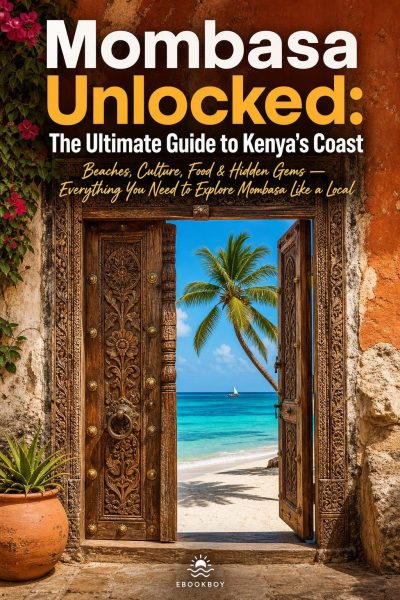
Mombasa Unlocked: The Ultimate Guide to Kenya's Coast
Beaches, Culture, Food & Hidden Gems — Everything You Need to Explore Mombasa Like a Local
EbookBoy · 98 pages · Edition 1 · Free sample: chapter 1
Chapter 1
Welcome to Mombasa: Africa's Ocean Jewel
Africa Begins at the Ocean
There is a moment, arriving in Mombasa for the first time, when the air itself tells you that you have arrived somewhere different. It hits you before you've cleared the airport — a warm, salt-heavy thickness that carries faint traces of frangipani, diesel, and something sweetly smoky you can't quite name. The light is different too: softer, more golden, bouncing off coral-stone walls and terracotta rooftops with a quality you won't find upcountry in Nairobi, let alone anywhere in Europe or North America.
Mombasa is Kenya's second-largest city and its only major port, but to describe it that way is like describing a cathedral as a large building with good acoustics. The statistics are technically accurate and entirely miss the point. This is a city that has been continuously inhabited for well over a thousand years, a place where Swahili traders, Arab merchants, Indian shopkeepers, Portuguese soldiers, and British colonial administrators have all left their fingerprints — on the architecture, the food, the language, the religion, and the faces of the people who call this coast home.
If Nairobi is Kenya's head — fast, ambitious, wired for the future — then Mombasa is its soul. And its soul is ancient, layered, and deeply, defiantly its own.
A City Built on Trade Winds
To understand Mombasa, you need to understand the kusi and the kaskazi — the two monsoon winds that shaped the entire history of this coast.
For millennia, the Indian Ocean wasn't a barrier between Africa, Arabia, Persia, India, and Southeast Asia. It was a highway. The monsoon winds blew reliably in two directions: the kaskazi (northeast monsoon) carried dhows down from Arabia and India between November and March, while the kusi (southeast monsoon) blew them home again between April and October. Mombasa sat perfectly positioned on this ancient maritime trade route, and its natural deep-water harbour made it the most logical stopping point on the entire East African coast.
Arab traders began settling the area around the 8th and 9th centuries CE, intermarrying with the local Bantu-speaking African populations and gradually developing what we now call Swahili culture — a word that itself comes from the Arabic sawahil, meaning "coasts." The result was something genuinely new: not Arab, not purely African, but a synthesis that produced its own language (Kiswahili), its own architectural style (those famous carved wooden doors), its own cuisine, and its own vibrant urban identity.
By the 13th century, Mombasa was already one of the most important ports on the East African coast, trading in ivory, gold, iron, and enslaved people — a history that deserves acknowledgement, not erasure. The city's wealth attracted attention, and with attention came conflict.
The Layers of Conquest
The Portuguese arrived in 1498 when Vasco da Gama sailed into the harbour, guns pointing, demanding tribute. What followed was nearly two centuries of brutal Portuguese domination, punctuated by repeated sieges, massacres, and resistance. Fort Jesus — the great coral-stone fortress that still stands at the edge of the Old Town today — was built by the Portuguese in 1593 and remains one of the most remarkable pieces of military architecture in sub-Saharan Africa.
The Omanis eventually drove the Portuguese out in 1698 after a siege of Fort Jesus that lasted 33 months — a piece of stubbornness on both sides that says something about how much this city was worth fighting for. The Omani Arabs then controlled the coast for much of the next two centuries, building their own political and trade networks, and leaving a deep imprint on the Islamic character of coastal culture that persists to this day.
The British arrived in the late 19th century as part of the great European scramble for Africa, and Mombasa became the administrative capital of the East Africa Protectorate before that role was eventually transferred to Nairobi. The British built the Uganda Railway — a colossal and controversial feat of engineering that was laid using tens of thousands of indentured labourers brought from India — and it was this railway that both transformed Mombasa's economic importance and brought the Indian community that remains a vital part of the city's fabric today.
Kenya gained independence in 1963, and Mombasa became part of the new nation — though the coast has always maintained a somewhat distinct identity from the interior, and that sense of coastal separateness is something you'll feel and hear about if you spend any real time here.
All of this history isn't just background. It's present. You can taste it in the biryani, see it in the carved Arabic calligraphy above a doorway, hear it in the call to prayer echoing across Old Town at dawn, and feel it in the particular pride with which a mswahili — a person of the coast — will tell you about their home.
The Geography: Island, Mainland, and the Blue Beyond
Mombasa proper sits on a small island roughly 15 kilometres long and 8 kilometres wide, separated from the mainland by two tidal creeks: Tudor Creek to the north and Kilindini Harbour to the south. The island is connected to the mainland by the Nyali Bridge to the north, the Makupa Causeway to the west, and the Likoni Ferry to the south — the latter being a Mombasa experience in itself, a clanging, crowded, salt-sprayed crossing that tens of thousands of people make every single day.
The island hosts the historic Old Town, the commercial centre, and the port. But what most visitors think of as "Mombasa" — the beaches, the resorts, the beach bars — is actually the mainland north and south of the island.
To the north, the Nyali, Bamburi, and Shanzu beaches stretch up the coast, growing progressively quieter as you go further from the city. To the south, across the Likoni Ferry, lies a different world entirely: the quieter, more rural south coast, culminating in Diani Beach, which regularly appears on lists of the world's most beautiful beaches and is separated from the hustle of the city by about 30 kilometres of coastal road.
The Indian Ocean itself deserves a paragraph of its own. It is, quite simply, one of the most beautiful bodies of water on earth in this part of the world — warm (typically 26–29°C), a shifting palette of turquoise and deep blue depending on depth, and protected along much of the coast by a coral reef that creates calm, swimmable lagoons. The reef is both a wonder and a responsibility; we'll talk more about how to enjoy it without contributing to its destruction in later chapters.
The People: A Coastal Mosaic
Walk through Mombasa for a single afternoon and you will encounter a human diversity that is genuinely remarkable. The majority of the city's roughly 1.2 million residents are members of the Mijikenda — a collective name for nine related Bantu-speaking groups (including the Giriama, Digo, and Duruma) who have lived along this coast for centuries. The Swahili people, who identify specifically with the coastal Islamic culture that developed from Arab-African intermingling, form another significant community, concentrated particularly in Old Town and the island.
The Indian community — primarily of Gujarati and Goan origin — has been present since the railway era and before, and their influence is visible in the ornate Hindu temples that sit incongruously (and beautifully) beside mosques in the Old Town, in the best curry houses in the city, and in many of the businesses that keep Mombasa's commercial heart beating.
There are also significant numbers of upcountry Kenyans — Kikuyu, Luo, Kamba, and others — who have come to the coast for work and opportunity, giving the city an additional layer of cultural texture. And there is a small but visible community of European and other foreign residents, mostly involved in tourism, NGOs, or business.
What strikes most visitors is not the diversity itself — many cities are diverse — but how it functions. This is not a city without tensions; it has its fault lines, its politics, its historical grievances. But on a daily street level, there is a quality of coexistence that feels genuinely earned. In a single block you might pass a mosque, a temple, a church, and a Rastafarian craft stall. Nobody seems to find this particularly remarkable. That, in itself, is remarkable.
The Rhythm of Coastal Life
Mombasa operates on a different clock to the rest of Kenya, and the sooner you accept this, the happier you will be.
Pole pole — slowly, slowly — is both a Swahili phrase and a philosophy. The heat encourages it. The culture supports it. The ocean, visible or sensed from almost anywhere on the island, insists on it. Things happen when they happen. The matatu departs when it's full. The restaurant serves you when the food is ready. The sunset takes as long as it takes, and it is worth every minute.
This is not laziness. It is a different relationship with time — one that prioritises quality of experience over efficiency of schedule. Once you stop fighting it and start inhabiting it, Mombasa becomes a profoundly pleasurable place to exist in.
The city has its own daily rhythms too. Mornings are animated early — markets busy, chai karibu (welcome tea) being poured at roadside stalls, the smell of mandazi (fried dough) and mahamri drifting from small kitchens. Midday brings a heat-induced lull, especially in the months between November and April when temperatures regularly reach 33–35°C. Late afternoons revive everything — the beaches fill, the markets reopen, children pour out of schools in their white uniforms. Evenings are the best time: cooler, fragrant, alive with music and conversation and the smell of nyama choma grilling somewhere nearby.
During Ramadan — the Islamic holy month that falls on a different part of the calendar each year — the rhythm shifts again. Days are quieter, fasting observed with genuine devotion by much of the population. But after sunset, when the fast breaks with iftar, the city comes alive in a way that is extraordinary to witness: streets full of families sharing food, lights strung between buildings, a communal warmth that a visitor who happens to be present for it will never forget.
Why Mombasa Now?
Mombasa has been "discovered" many times over — by Arab traders, Portuguese conquistadors, British administrators, package-holiday tourists. Each wave of discovery has left its mark, not all of them welcome.
The city you will visit today is navigating a complex set of pressures: the economic importance of tourism versus the need to protect its cultural and environmental heritage; the pull of modernity against the weight of tradition; the politics of a coast that has sometimes felt neglected by a Nairobi-centric national government. These are live tensions, and being aware of them makes you a more thoughtful visitor.
But Mombasa is also, genuinely, a place of tremendous vitality. A food scene that is quietly extraordinary. Beaches that can still, if you know where to go, feel like private discoveries. A cultural heritage — Old Town, Fort Jesus, the living Swahili traditions — that is world-class by any measure. A warmth in the people, a genuine karibu (welcome), that doesn't feel performed for tourists.
The best thing you can do in Mombasa is slow down, stay curious, eat everything, and let the city reveal itself at its own pace. It will reward you generously.
A Quick Historical Timeline
For context, here's a condensed version of the key moments that shaped the city you're about to explore:
- 8th–9th century CE — Arab traders begin settling the East African coast; Swahili culture begins to develop
- 13th–15th century — Mombasa established as a major trading port; part of the Swahili Coast city-state network
- 1498 — Vasco da Gama arrives; beginning of Portuguese involvement on the coast
- 1593 — Fort Jesus built by the Portuguese
- 1698 — Omani Arabs capture Fort Jesus after a 33-month siege; Portuguese era ends
- 1824–1826 — Brief British protectorate over Mombasa, then withdrawn
- 1895 — Mombasa becomes capital of the British East Africa Protectorate
- 1896–1901 — Construction of the Uganda Railway, using mainly Indian indentured labour
- 1907 — Capital transferred from Mombasa to Nairobi
- 1963 — Kenyan independence; Mombasa becomes part of the new republic
- 2011 — Fort Jesus declared a UNESCO World Heritage Site
Key Takeaways
- Mombasa is a layered, ancient city shaped by Arab, African, Indian, and European influences — understanding this history enriches every experience you'll have here.
- The city sits on an island connected to the mainland by bridges and a ferry; most beaches are on the mainland north and south of the island.
- The population is a genuine mosaic of Mijikenda, Swahili, Indian, and upcountry Kenyan communities, plus a small expat presence.
- The coastal pace of life is deliberately slower than Nairobi — embrace pole pole and your trip will be infinitely better.
- The Indian Ocean along this coast is warm, beautiful, and largely protected by coral reef; it is one of Mombasa's greatest assets and deserves respect.
- Mombasa's food, culture, architecture, and natural environment are all world-class; the chapters that follow will help you access the best of all of them.