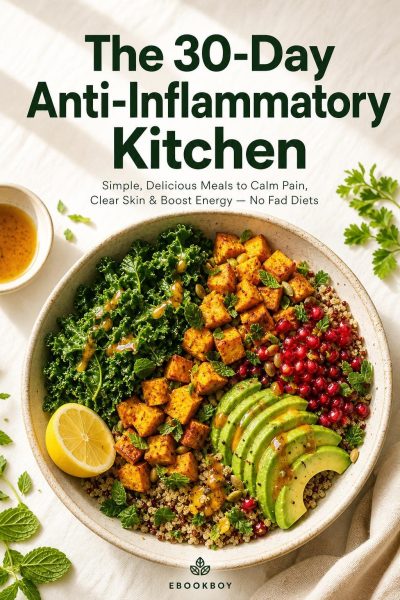
The 30-Day Anti-Inflammatory Kitchen
Simple, Delicious Meals to Calm Pain, Clear Skin & Boost Energy — No Fad Diets
EbookBoy · 103 pages · Edition 1 · Free sample: chapter 1
Chapter 1
Your Body Is Trying to Tell You Something
The Morning You Stopped Feeling Like Yourself
You probably can't point to the exact day it happened. There wasn't a dramatic collapse or a single bad test result. It was more like a slow dimming — the morning you realized you'd been waking up tired for months, that your knees ache before you've even made coffee, that the patch of flaky skin near your eyebrows has been there so long you've stopped noticing it. Maybe you've started canceling plans because the energy just isn't there. Maybe your brain feels like it's wrapped in wet wool by 2 p.m.
This is what chronic low-grade inflammation feels like from the inside. Not a crisis. Just a persistent, grinding erosion of the way you used to feel.
And here's the thing nobody tells you clearly enough: that erosion has a mechanism. It's not just aging. It's not just stress. It's not bad luck. A significant part of it is biological, measurable, and — this is the part worth sitting with — responsive to what you eat.
That's not a sales pitch. That's physiology.
What Inflammation Is Actually Doing to Your Days
Inflammation is your immune system's first responder. When you cut your finger or catch a cold, inflammation rushes to the scene, walls off the damage, and starts repairs. You need it. Without it, a splinter could kill you.
The problem isn't inflammation. The problem is inflammation that never gets the "all clear" signal. When the immune system stays partially activated day after day — not enough to make you acutely sick, but enough to keep your body in a constant low-level emergency — everything downstream suffers.
Consider what that looks like in real life:
Joint pain and stiffness. Inflammatory chemicals called cytokines irritate joint tissue. You feel it as morning stiffness, aching knees on stairs, or hands that take twenty minutes to loosen up.
Brain fog and fatigue. Inflammatory signaling crosses the blood-brain barrier and interferes with neurotransmitter production. Concentration becomes effortful. Words slip away mid-sentence. Sleep doesn't refresh you the way it should.
Skin flare-ups. Seborrheic dermatitis, eczema, acne, rosacea — all of these have inflammatory components. The skin is your largest organ, and it reports on what's happening internally with uncomfortable accuracy. When your gut lining is compromised or your immune system is overreactive, your skin is often the first visible sign.
Hormonal disruption. Chronic inflammation interferes with insulin signaling, cortisol regulation, and the hormonal cascades that govern menstrual cycles, thyroid function, and sleep rhythms. This is why so many people dealing with inflammation also deal with irregular periods, blood sugar crashes, and a persistent sense of being wired-but-tired.
Digestive distress. Bloating, unpredictable bowel habits, and that heavy feeling after meals you can't quite explain — these often trace back to an inflamed gut lining and a disrupted microbiome.
None of these symptoms exist in isolation. They're connected, because they share a root. Which means when you address the root, multiple things can shift at once. People who change their diet to reduce inflammation often report that their joint pain improves and their skin clears and their energy rebounds — not because they found a magic cure, but because they stopped pouring fuel on a fire that had been burning quietly for years.
Why Food Is the Most Accessible Lever You Have
There are many things that drive chronic inflammation: chronic stress, poor sleep, environmental toxins, sedentary habits, certain medications, and underlying health conditions. You can't fix all of those in 30 days. But food is the one variable you interact with three or more times every single day, and it has a direct, rapid effect on inflammatory pathways.
Every meal is either nudging your immune system toward calm or toward agitation. Not dramatically — no single meal will cure or cause disease. But cumulatively, over weeks and months, your dietary pattern shapes your inflammatory baseline the way water shapes stone.
The science here is not fringe. Research on dietary patterns and inflammatory markers — things like C-reactive protein, interleukin-6, and tumor necrosis factor-alpha — consistently shows that diets rich in refined carbohydrates, industrial seed oils, and ultra-processed foods are associated with higher inflammatory burden. Diets rich in vegetables, omega-3 fatty acids, fermented foods, and polyphenol-rich plants are associated with lower inflammatory burden and better outcomes across a remarkable range of conditions.
This book translates that research into something you can actually do on a Tuesday night when you're tired and hungry and the last thing you want is to make something complicated.
A note worth making here: Food is powerful, but it isn't medicine in the clinical sense, and this book isn't a substitute for medical care. If you have a diagnosed autoimmune condition, are on medication, or have symptoms that haven't been evaluated by a doctor, please work with a healthcare provider alongside any dietary changes you make. What you'll find here is a food-first approach that complements good medical care — not one that replaces it.
The 30-Day Promise (And What It Actually Means)
Thirty days is not a magic number. It's a practical one. It's long enough for your gut microbiome to begin shifting in response to new foods. It's long enough to break habitual eating patterns and build new ones. It's long enough to notice changes in how you feel — energy, skin, pain levels, digestion — that you can actually attribute to your food choices.
Here is what this 30-day plan promises:
It will not ask you to be hungry. Every recipe in this book is designed to be genuinely satisfying. Anti-inflammatory eating is not the same as low-calorie eating. You'll eat full meals with healthy fats, quality proteins, and complex carbohydrates. Hunger is not the goal; nourishment is.
It will not require expensive specialty ingredients. Every chapter includes budget-friendly swaps. Frozen wild salmon works. Canned sardines work. Dried lentils work. You do not need to shop at a specialty grocer or spend more than you're spending now.
It will not demand perfection. There is a chapter specifically about social eating, restaurants, travel, and cravings — because life doesn't pause for your health goals. An 80/20 approach, applied consistently, beats a perfect approach that collapses at the first dinner party.
It will give you a system, not just a list. By day 30, you'll understand why certain foods help and others hurt. You'll have a repeatable weekly rhythm, a stocked pantry, and enough recipes to keep things interesting. You won't need this plan forever — because you'll have internalized the principles.
Here is what this plan doesn't promise: that you'll never have another bad day, that inflammation will vanish completely, or that food alone will resolve every symptom you're experiencing. The body is complex. But most people who complete this 30 days report feeling meaningfully better — and more importantly, feeling capable of maintaining those changes.
How This Book Is Structured
Think of the four weeks as a progression, not a rigid prescription.
Week 1 — Reset focuses on gut lining support and blood-sugar stabilization. The recipes are simple (most under 20 minutes), and the emphasis is on crowding out the most inflammatory foods rather than dramatic restriction. Breakfasts and broths anchor this week because they set the tone for your blood sugar and gut health from the very first meal of each day.
Week 2 — Build introduces more variety: polyphenol-rich vegetables, legumes, fermented foods, and the healthy fats your cells are genuinely hungry for. Lunch recipes are the focus here, with meal-prep strategies that make the whole week easier.
Week 3 — Nourish brings in the dinners — satisfying, family-friendly meals that don't announce themselves as "health food." This is where the plan becomes sustainable, because the food is genuinely good enough to cook for people who don't care about inflammation.
Week 4 — Sustain tackles the hardest terrain: snacks, sweets, social situations, and travel. It's where most eating plans fall apart, and it's where this one is designed to hold.
Beyond the four weeks, you'll find targeted chapters on skin health and the gut-skin axis, joint and hormonal health, and a full guide to life after day 30 — including how to reintroduce foods, identify personal triggers, and build a rhythm that lasts.
Before You Begin: A Simple Starting-Point Check-In
Before you cook a single recipe, take five minutes with this exercise. You don't need to share it with anyone. It's just a baseline — so that in 30 days, you have something concrete to compare against.
Rate each of the following on a scale of 1–5: (1 = rarely/not at all, 5 = daily/severely)
- Joint or muscle pain or stiffness: _
- Morning fatigue even after adequate sleep: _
- Brain fog or difficulty concentrating: _
- Skin issues (flaking, redness, breakouts, rashes): _
- Digestive discomfort (bloating, irregularity, heaviness): _
- Mood instability or irritability without clear cause: _
- Energy crashes in the afternoon: _
- Food cravings that feel urgent or hard to manage: _
Add up your score. Write it down somewhere — a notebook, a phone note, the inside cover of this book. Don't judge it. It's just information.
If you scored above 20, you're likely dealing with a meaningful inflammatory burden, and you'll probably notice changes within the first two weeks. If you scored between 10 and 20, the changes may be subtler but still significant. If you scored below 10, you're probably here for maintenance and optimization — and there's plenty here for you too.
Repeat this check-in at day 15 and day 30. The numbers won't always move in a straight line, but the trend matters.
A Word About the "No Fad Diets" Subtitle
You may have picked up this book because you've already tried things — maybe keto, maybe elimination diets, maybe various supplements — and you're tired of approaches that require enormous effort, eliminate entire food groups permanently, or make you feel like a failure when life intervenes.
This plan is not a fad diet. It is not built around a single macronutrient or a branded protocol. It draws on what the research consistently supports across multiple well-studied dietary patterns — Mediterranean, traditional Japanese, and traditional plant-rich diets from cultures with lower rates of chronic inflammatory disease — and distills those patterns into practical, everyday cooking.
You will eat carbohydrates. You will eat fat. You will eat protein. You will not be asked to count anything unless you want to. What you'll do is shift the quality and composition of what you eat, which is a very different thing from restriction.
The recipes in this book were developed to taste good first. Every single one was tested in a real kitchen with real constraints — weeknight time pressure, limited budgets, picky family members, and the very human need to enjoy what you eat. If the food isn't good, no one stays on the plan. That's not a compromise of the principles; it's the only way the principles work.
Your Kitchen Is Already a Pharmacy
Here is a reframe worth carrying through this entire book:
Every time you open your refrigerator, you are making a prescribing decision. Not a moral one — food is not virtue — but a biochemical one. Turmeric contains curcumin, which modulates inflammatory pathways. Fatty fish contains EPA and DHA, which are direct precursors to anti-inflammatory compounds your body produces. Fermented foods introduce bacterial strains that compete with inflammatory microbes in your gut. Dark leafy greens contain vitamin K and folate, which support vascular health and reduce oxidative stress. Blueberries contain anthocyanins that cross the blood-brain barrier and reduce neuroinflammation.
None of this requires a prescription. None of it requires a special degree to understand or apply. It requires a shopping list, a bit of planning, and a willingness to cook — or to heat things up, because some of the most powerful recipes in this book are barely recipes at all.
Your kitchen is already a pharmacy. This book is the instruction manual.
Key Takeaways
- Chronic low-grade inflammation is a real, biological phenomenon that underlies many common, frustrating symptoms — joint pain, fatigue, brain fog, skin flare-ups, and hormonal disruption — and it often develops so gradually that it feels like "just aging" or "just stress."
- Food is the most frequently accessible lever for influencing your inflammatory baseline. Every meal either nudges the immune system toward calm or toward agitation — not dramatically in isolation, but cumulatively over time.
- This 30-day plan is not a fad diet. It doesn't eliminate food groups, require calorie counting, or demand perfection. It shifts the quality and composition of what you eat, based on patterns supported by consistent research across multiple traditional dietary cultures.
- The plan is structured as a four-week progression — Reset, Build, Nourish, Sustain — designed to build habits gradually and address the hardest challenges (social eating, cravings, travel) before they derail progress.
- Before you begin cooking, complete the starting-point check-in and record your score. You'll repeat it at days 15 and 30 to track real, observable changes rather than relying on memory.
- Food is not medicine in the clinical sense. If you have diagnosed conditions or unresolved symptoms, work with a healthcare provider. This plan is designed to complement good care, not replace it.
- Your kitchen is already one of the most powerful tools you have for feeling better. This book is the instruction manual for using it.