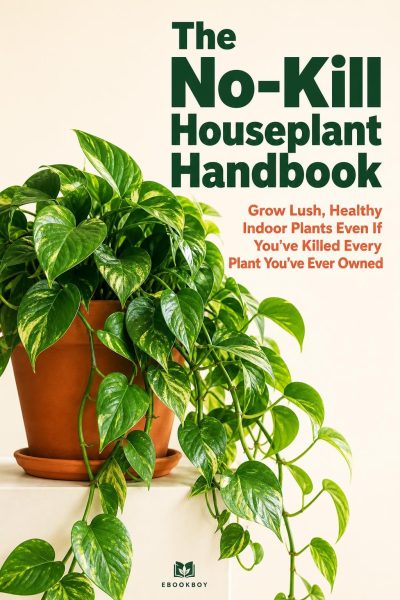
The No-Kill Houseplant Handbook
Grow Lush, Healthy Indoor Plants Even If You've Killed Every Plant You've Ever Owned
EbookBoy · 106 pages · Edition 1 · Free sample: chapter 1
Chapter 1
Why Your Plants Keep Dying (And Why It's Not Your Fault)
The Myth of the Green Thumb
Let's start with something important: there is no such thing as a green thumb.
Not in the way people mean it, anyway. When someone says they have a green thumb, what they're really saying is that they've learned — through trial, error, and probably a few plant funerals — how to pay attention to what plants actually need. It's a skill, not a gift. And skills can be learned.
The flip side of this myth is the one you might have told yourself: I'm just not a plant person. I kill everything I touch. It's almost certainly not true. What's more likely is that you were given the wrong plant for your home, or the wrong advice for that plant, or both. You weren't failed by some missing gene for horticulture. You were failed by a system that hands people a potted fern and says "good luck."
This book is going to fix that.
Before we get into the specifics — and we will get very specific, chapter by chapter — it helps to understand the big picture. Because the vast majority of houseplant deaths, from the crispiest cactus to the most dramatically collapsed fiddle-leaf fig, come down to three causes. Just three. And once you understand them, you'll start seeing plant problems differently. Not as mysterious failures, but as puzzles with clear solutions.
The Three Real Reasons Plants Die
Reason One: Wrong Light
This is the biggest one. It's responsible for more houseplant deaths than anything else, and it's almost entirely invisible to new plant owners because the problem doesn't show up immediately.
Here's what happens: you buy a beautiful monstera from a garden centre where it's been sitting under commercial grow lights and greenhouse glass. You bring it home and put it in the corner of your living room because that's where it looks best. The corner is about three metres from your north-facing window. The plant looks fine for three or four weeks — it's living off the energy it already stored. Then it starts looking a bit sad. Leaves get smaller. Growth slows down. Eventually it starts yellowing from the bottom up. By the time most people notice something is wrong, the plant has been slowly starving for months.
Light is food for plants. Not a nice-to-have, not a decorative preference — it's the fundamental fuel they run on. Too little, and they slowly exhaust themselves. Too much direct sun through a south-facing window, and a shade-lover scorches within days.
The tricky part is that "bright light" means something very different to a plant than it does to a human. You might walk into a room and think it looks perfectly bright and cheerful. Your spider plant disagrees. We'll cover how to actually read your home's light in Chapter 2, including a simple test that takes about sixty seconds and costs nothing.
For now, the key thing to absorb is this: the most loving thing you can do for a new plant is put it in the right light, not the most convenient spot.
Reason Two: Wrong Water
If light is the most common killer, overwatering is the most misunderstood one. Ask most people why their plant died, and they'll guess they didn't water it enough. In reality, the opposite is usually true.
Overwatering doesn't mean you literally poured too much water on the plant in one go. It means you watered too frequently — before the soil had a chance to dry out enough. The result is soil that stays constantly wet, which starves the roots of oxygen and creates the perfect conditions for root rot, a fungal condition that destroys the root system from the ground up.
Here's the cruel irony: a plant suffering from root rot looks almost identical to an underwatered plant. The leaves droop. They might yellow. The plant looks thirsty. So you water it more. And the problem gets worse.
The "more love, more water" instinct is completely understandable. We associate care with giving. But most popular houseplants — pothos, snake plants, ZZ plants, succulents — evolved in environments where water was irregular and soil dried out between rains. They are not expecting a drink every other day. Many of them are genuinely happier being slightly neglected.
There's also a second watering mistake that's almost as common: using the wrong pot or soil, which keeps moisture sitting around longer than it should. We'll get to that in Reason Three.
The right watering approach is simple once you know it, and we'll cover it fully in Chapter 3, including a finger-test method and a seasonal guide (because how often you water in January should be different from how often you water in July).
Reason Three: Wrong Pot
This one surprises people, but the pot your plant lives in matters enormously — and most plants come from shops in exactly the wrong pot.
Walk into any garden centre or supermarket plant section and you'll notice that plants are usually sold in small, flimsy plastic nursery pots. Sometimes they've already been repotted into a slightly larger decorative pot with no drainage hole. Both of these situations can cause problems.
The two things that matter most about a pot are its size and whether it has drainage holes.
Drainage holes first: without a hole in the bottom of the pot, excess water has nowhere to go. It sits at the base of the pot, keeps the roots wet, and — you guessed it — leads to root rot. Many decorative pots are solid at the bottom because they're designed to look beautiful, not to grow plants. The solution isn't to throw them out; it's to keep your plant in its plastic nursery pot with drainage holes, and sit that inside the decorative pot. Then when you water, lift the nursery pot out, water it over a sink until it drains freely, and put it back.
Size matters because of something called "wet soil volume." If you put a small plant in a very large pot and water it, most of that soil stays wet for a long time because the plant's roots can't absorb it quickly. All that wet soil around the roots is, again, a recipe for rot. The general rule is to only go up one pot size at a time when repotting — usually about 2–5 cm wider than the current pot.
The other pot-related issue is material. Terracotta pots are porous, which means they breathe and dry out faster — great for plants that like to dry between waterings, like succulents and cacti. Plastic and glazed ceramic hold moisture longer — better for plants that like consistent moisture, like ferns and peace lilies. This isn't a rigid rule, but it's useful to know.
We'll go much deeper on soil, pots, and repotting in Chapter 4.
Why Advice Often Makes Things Worse
There's one more thing worth addressing before we move on: a lot of the advice floating around about houseplants is vague to the point of uselessness.
"Water when the soil is dry." How dry? Bone dry? Slightly dry an inch down?
"Needs bright, indirect light." What does that mean in a flat with north-facing windows?
"Fertilise regularly." How regularly? With what? Starting when?
This kind of advice isn't wrong exactly — it just assumes a level of background knowledge that most beginners don't have yet. If you've ever followed the instructions on a plant label and still watched the plant decline, it's probably because the label was written for someone who already knew what they were doing.
This book is written for someone who doesn't — yet. Every piece of advice in here will be specific enough to actually act on. When I say "water when the top 5 cm of soil feels dry," I mean you stick your finger in the soil up to your second knuckle and if it comes out with no damp soil clinging to it, it's time to water. That kind of specific.
A Quick Confidence Reset
Before we go any further, let's do a short exercise. It takes two minutes and it's worth doing now rather than skipping.
Think about the last plant you killed. (If you haven't killed one, think about the one that's struggling right now.)
Now ask yourself these questions honestly:
- Where was it sitting? How far from a window? Which direction did the window face?
- How often did you water it? Did you have a schedule, or did you water when you remembered, or when it looked sad?
- What pot was it in? Did the pot have drainage holes? Was it recently repotted into a much bigger pot?
If you can't answer all of these questions, that's actually the answer. The plant died not because you have a black thumb, but because you didn't yet have the information you needed to make good decisions. That's not a character flaw. That's just being new to something.
Now consider this: most of the plants sold as houseplants are remarkably tough. Pothos, snake plants, philodendrons, ZZ plants — these are not delicate creatures. They have survived neglect, dim offices, over-enthusiastic waterers, and complete beginners for decades. They want to live. Your job isn't to perform some complex horticultural ritual. Your job is to stop doing the things that work against them.
That's genuinely achievable. You're going to be fine.
How This Book Works
Each chapter in this handbook builds on the last, but you don't have to read it in order. If you have a specific problem — a plant covered in tiny bugs, a mystery yellowing situation, a bathroom with no natural light — you can jump straight to the relevant chapter.
Here's a rough map:
- Chapters 2–4 cover the fundamentals: light, water, soil, and pots. These are the chapters that will prevent 90% of future plant deaths.
- Chapter 5 is your plant shopping guide — 20 profiles of beginner-friendly plants, ranked by difficulty, so you can choose the right plant for your actual home.
- Chapter 6 is the quick-diagnosis chart. Bookmark it. Come back to it whenever something looks wrong.
- Chapters 7–9 go deeper on environment, feeding, and dealing with pests and disease.
- Chapters 10–11 are for when things are going well — propagating new plants and keeping up with seasonal care.
- Chapter 12 is about making your space genuinely beautiful with plants, and includes a 30-day starter plan to put everything into practice.
You don't need any special equipment to get started. You don't need a garden, a greenhouse, or a south-facing home full of skylights. You need this book, a few good plants matched to your actual conditions, and the willingness to learn a new way of paying attention.
The No-Kill Philosophy
One last thing, and then we'll get into the practical stuff.
This book is called The No-Kill Houseplant Handbook, but let's be honest with each other: plants sometimes die. Even experienced plant owners lose plants. Sometimes a plant arrives from the shop already stressed. Sometimes a pest gets out of control before you notice it. Sometimes a plant just doesn't suit your home, no matter what you do.
The goal isn't perfection. The goal is understanding — knowing enough about why plants thrive and why they struggle that you can make better decisions, catch problems early, and give your plants a genuinely good environment. When that's in place, most plants don't just survive. They grow. They trail across your shelves and push out new leaves and occasionally do something so unexpectedly beautiful that you find yourself genuinely delighted.
That's what's waiting on the other side of this learning curve. Let's get you there.
Key Takeaways
- The "green thumb" is a learned skill, not an inborn talent. Anyone can grow healthy houseplants with the right knowledge.
- The three main reasons houseplants die are: wrong light, wrong water, and wrong pot — not personal failure or bad luck.
- Most houseplant deaths are caused by overwatering, not underwatering. The symptoms look similar, which is why it's so often misdiagnosed.
- Vague plant care advice fails beginners because it assumes background knowledge they don't have yet. Specific, actionable guidance makes the real difference.
- The plants most commonly sold as houseplants are tough and resilient. They want to survive. Your job is to stop working against them.
- Before your next plant purchase, you'll want to know your home's light conditions, have a watering approach that responds to the soil rather than the calendar, and choose a pot with drainage holes in an appropriate size.