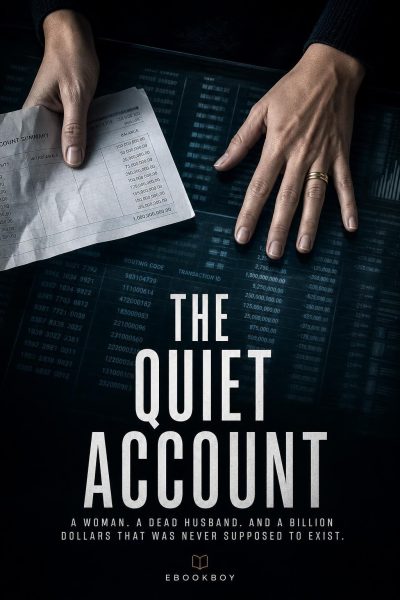
The Quiet Account
A woman. A dead husband. And a billion dollars that was never supposed to exist.
EbookBoy · 149 pages · Edition 1 · Free sample: chapter 1
Chapter 1
The Estate of Daniel Voss
The law firm of Brandt, Kessler & Hauf occupied the top two floors of a building on Bahnhofstrasse that had been designed to look older than it was. Mara Voss had always appreciated that particular deception. In Zurich, the appearance of permanence was its own form of capital.
She arrived at nine o'clock precisely, twelve days after her husband's funeral, wearing the charcoal wool coat she had bought in Geneva the previous winter. She had chosen it that morning for the same reason she chose everything now — because Daniel had never seen it. Because putting on something he had never touched felt, briefly, like breathing.
The receptionist was young and very sorry. She said so twice before Mara had cleared the security barrier.
"We all are," Mara said, and let the woman lead her to the conference room without further ceremony.
The room looked out over the lake. On a clear day in October, the water was the color of pewter, and the mountains beyond it were beginning to show white at their peaks. Mara had sat in rooms like this for twenty years — rooms designed to suggest that money was a natural phenomenon, as permanent and blameless as geology. She set her bag on the conference table and did not look at the view.
She was a forensic accountant. She had been one for longer than she had been Daniel's wife. The work had a grammar to it that grief did not disturb, and she was grateful for that. Numbers held their shape. Numbers did not shift their meaning in the middle of the night.
She opened her laptop and took out her notebook — paper, always paper for first observations — and waited for Brandt, Kessler & Hauf's senior partner to arrive.
His name was Werner Hauf. He was sixty-three, silver-haired, and dressed in a suit that cost more than most people's monthly rent. Mara had met him twice: once at a firm dinner four years ago, once at Daniel's funeral, where he had held her hand and said that Daniel was one of the finest legal minds he had ever encountered.
She had believed him then. She was professionally uncertain of everything now.
He came through the door carrying a leather portfolio and followed by a younger associate she didn't recognize — a woman in her thirties with close-cropped hair and an expression of careful neutrality. Hauf introduced her as Claudine Metz, the firm's head of client accounts. Neither of them offered coffee.
"Mara." Hauf set his portfolio on the table and did not open it. "We appreciate you coming in personally. Given the circumstances, no one would have — "
"I'm the executor," Mara said. "The estate requires an independent audit before probate can proceed. This is the most efficient way to begin."
She watched his hands as she said it. They were resting flat on the table, and they were perfectly still, and she noted that he was making them be still. There was a difference. Twenty years of reading people across conference tables had taught her to see the effort behind the calm.
"Of course," he said. "We've prepared a summary of Daniel's holdings as the firm understood them. Accounts under management, the pension instruments, the property interests." He nodded to Claudine, who opened a manila folder and slid a document across the table.
Mara picked it up. Four pages. Clean margins. A total figure at the bottom of the final page that was substantial — Daniel had done well, better than she had ever asked about, because they had agreed early in their marriage to keep their finances professionally separate. She had thought it was healthy. She thought a great many things now that she was revising.
She read through the summary at the speed she always read, which was faster than most people expected. Claudine watched her with the careful expression. Hauf watched the window.
"This is the firm's understanding of his holdings," Mara said. "What about accounts he managed independently? Personal accounts not administered through Brandt Kessler?"
"We've included everything we have visibility into," Hauf said.
"That's not what I asked."
A pause. Claudine looked at Hauf. Hauf looked at Mara.
"Daniel was a private man," he said.
"Yes." Mara set the document down. "He was."
She let the silence sit for a moment. In her experience, silence in a conference room was a precision instrument. People filled it with whatever they most needed to conceal.
"There are additional materials," Claudine said finally. Her voice was measured, but something in it was off by a fraction — a note of relief, almost, as though she had been waiting for permission to speak. "Personal files. His office computer has been imaged per our standard protocol following — following the circumstances of his death. You're entitled to those as executor."
"I'd like them now," Mara said.
"We can arrange a — "
"Now, please."
They gave her Daniel's office.
It was smaller than she'd imagined. She had visited the firm only a handful of times over eight years of marriage, and she had never been to Daniel's actual workspace — she had always been collected from the lobby, taken to dinner, returned to their apartment in the Seefeld district with its view of the church spire and the smell of the lake coming through the windows in summer.
The office had a desk, a bookcase, a single framed photograph of the two of them in Lisbon, and a window that looked not over the lake but into a narrow light well between buildings. The light was gray and indirect and constant. She thought: he looked at this every day. This is what he saw.
She sat down in his chair and opened the laptop Claudine had left for her, already logged in under a guest account with access to Daniel's imaged files. A neat, bureaucratic kindness. She was grateful for it in a way she didn't examine.
The files were organized in folders, all labeled, all dated. Daniel had been meticulous. She had always known that about him — it was one of the things that had made their marriage legible, two careful people who understood that order was a form of love. She moved through the folders methodically: correspondence, case notes, reference materials, a folder labeled simply Personal that she saved for last, the way you save the thing you most fear opening.
She was forty minutes in when she found the anomaly.
It was not in the folders Claudine had flagged. It was in the email client, in a subfolder nested inside a folder labeled Archive — Compliance 2021, which was exactly the kind of location someone would choose if they wanted a thing to be findable only by someone who knew to look. Or by someone who looked at everything.
Mara looked at everything.
The subfolder contained a single email, sent from an external address to Daniel's private firm account fourteen months ago. The sender address was a string of characters that resolved to nothing — a burner account, already dead. The subject line was blank. The body of the email contained one item: an account number.
Not a name. Not a bank. Not a currency denomination or a balance or an explanation. Just the number itself, twenty-two digits, formatted in a way she recognized immediately because she had spent her career learning to recognize such things.
Her hand stopped moving over the touchpad.
The format was IBAN-adjacent but not quite IBAN. The prefix was a two-letter code she associated with a specific category of private banking architecture — the kind used by institutions that operated in jurisdictions where disclosure requirements were more theoretical than practical. Luxembourg. Liechtenstein. The quieter corners of Singapore.
Twenty-two digits.
She looked at the number for a long time without writing it down.
Then she took out her phone.
The photograph took less than three seconds. She had done it before — not often, but in circumstances where she had reason to believe that a document might not survive the morning. She angled the phone to avoid glare from the gray light-well window, tapped the screen twice, and slipped the phone back into her jacket pocket before the camera sound had finished.
She was looking at the laptop again, expression unchanged, when the door opened.
It was Hauf. He had a cup of coffee he hadn't offered her and an expression she now recognized as the managed version of something much less composed.
"How are you getting on?" he asked.
"Making progress." She closed the email client with a single keystroke. "The personal correspondence will take some time to review. I may need to come back tomorrow."
He nodded too quickly. "Of course. We can arrange whatever access you need."
"I appreciate it." She looked up at him. He was standing in the doorway rather than entering, which was interesting. "Werner. How did Daniel seem to you in the last few months? Before the accident."
The word accident was doing a great deal of work in every conversation she'd had since the phone call twelve days ago. Daniel had died in a single-vehicle collision on a mountain road outside Chur on a dry Tuesday afternoon. The police report was competent and conclusive and contained no irregularities. She had read it four times.
Hauf considered his answer. "Focused," he said finally. "Perhaps a little — withdrawn. We attributed it to a demanding period of work. He had taken on some complex client matters."
"Complex how?"
"Cross-jurisdictional. Some international structuring work." He shifted his weight. "Nothing unusual for a practice like ours."
"No," Mara said. "Of course not."
She smiled at him, and he smiled back, and they were both doing the same thing — being careful — but only one of them knew it.
"I'll let you get on," he said, and pulled the door closed behind him.
Mara waited until she heard his footsteps recede down the corridor. Then she took out her phone and looked at the photograph she had taken.
Twenty-two digits, sharp and clear in the gray morning light.
She opened her notebook — paper, always paper for first observations — and wrote the number down by hand, pressing hard enough that the impression would survive the page.
Then she sat back in her dead husband's chair, in his narrow office with its gray light and its view of nothing, and she did what she always did when she encountered a number that didn't belong.
She began to think about where it had come from.
She had met Daniel at a conference in Basel. He was presenting on cross-border estate law; she was on a panel about forensic analysis in inheritance disputes. They had argued, politely, about the point at which legal structure became financial obfuscation. He had said the line was a matter of intent. She had said intent was unprovable and therefore irrelevant — what mattered was the architecture.
He had laughed. She had not, quite.
They had dinner that night, and then three more times in the following month, and then for eight years after that. He was meticulous and occasionally exasperating and he made excellent coffee and he read novels in French because he said they had better endings. She had loved him in the specific, structural way that suited her — not blindly, not with the kind of total surrender that frightened her, but with a steady, load-bearing certainty. He was part of the architecture of her life.
She had not known that he was building something else.
She looked at the number in her notebook.
Twenty-two digits. A door with no handle on her side.
She thought about the email sender — the dead burner account, the blank subject line. Someone had sent Daniel an account number and nothing else. Which meant Daniel had known what to do with it. Which meant the account number was not new information but confirmation — a key being handed over, not a map.
She thought about the subfolder nested inside the compliance archive. Daniel had been a careful man. He would not have left the email where she could find it unless he intended her to find it, or unless he had been careless in a way that was, for him, unprecedented.
She did not believe in unprecedented carelessness. Not from Daniel. Not in a file she was authorized to access.
He left it for me.
The thought arrived fully formed and she examined it the way she examined everything — looking for the flaw, the motive, the alternative explanation. She found several. But the one that felt most structurally sound, the one that bore the most weight without cracking, was this: Daniel had known something was wrong, and he had known she might be the one to go looking, and he had left her the first number in a sequence she hadn't finished reading yet.
Intent is unprovable, she had told him in Basel.
It matters anyway, he had said.
She closed her notebook and put it in her bag. She shut down the guest account on the laptop and left it as she had found it. She gathered her coat from the back of his chair and stood in the office for a moment, looking at the photograph of the two of them in Lisbon. She was laughing in it. She couldn't remember now what he had said to make her laugh, and the not-remembering was a specific kind of loss she hadn't catalogued yet.
She left it on the wall. It belonged there.
Claudine was waiting in the corridor, which was either coincidence or it wasn't.
"Finished for today?" she asked.
"For now." Mara buttoned her coat. "I'll need access again tomorrow morning. Eight o'clock if possible."
"I'll arrange it." Claudine paused. "Mrs. Voss — " She stopped.
"Mara."
"Mara." She lowered her voice, though the corridor was empty. "The account summary we gave you this morning. I want you to know that I prepared it from the materials we were given. I prepared it accurately from those materials."
Mara looked at her. Claudine's expression was still careful, still neutral, but her eyes were doing something different — communicating something that her professional training was trying to suppress.
"I understand," Mara said.
"I just wanted to be clear about that."
"You've been very clear." Mara held her gaze for a moment. "If there's anything else you want to be clear about, you have my number."
She walked to the elevator and pressed the button and stood with her bag over her shoulder and her notebook inside it and the photograph on her phone and the number in her hand, which was not shaking.
She was a forensic accountant. She had been one for twenty years. She knew that every transaction left a record, that every deletion left a ghost, that money in motion was never truly invisible — it only appeared that way to people who didn't know where to look.
She knew where to look.
The elevator arrived. She stepped in. The doors closed on Bahnhofstrasse, on the pewter lake, on the building designed to look older than it was, on Werner Hauf's still hands and Claudine Metz's careful eyes and a narrow office with a gray light and a photograph of a woman laughing at something she could no longer remember.
The number had twenty-two digits.
She already knew it was going to be the most expensive number she had ever read.